You are using an out of date browser. It may not display this or other websites correctly.
You should upgrade or use an alternative browser.
You should upgrade or use an alternative browser.
Fictional Album Art
- Thread starter Azas
- Start date

Azas
Waiting for the Barbarians
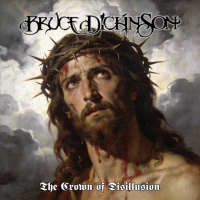
THE CROWN OF DISILLUSION
Bruce Dickinson returns with a thunderous reckoningThere are albums that arrive with anticipation… and then there are albums that arrive like a verdict.
With The Crown of Disillusion, Bruce Dickinson does not revisit the past—he confronts it, dismantles it, and sets it on fire. This is the first time in his solo career that he steps fully into thrash territory, yet what emerges is not a genre exercise. It is something far more dangerous: a collision between the cold, angular aggression of ...And Justice for All and the esoteric fire of The Chemical Wedding.
The result?
An album that is relentless, intricate, and spiritually corrosive. The most uncompromising, confrontational, and musically ferocious record of his entire career—a work that dares to ask:
What if there was sacrifice… and nothing came of it?
A NEW SONIC WEAPON
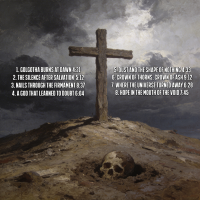
From the opening strike of “Golgotha Burns at Dawn”, it’s clear this is not familiar ground. The riffs are dry, serrated, and unyielding, built on shifting rhythmic frameworks that refuse easy resolution. The guitars don’t simply chug—they interlock and fracture, creating a lattice of tension that recalls late-80s progressive thrash, yet elevated with Dickinson’s signature sense of drama.Bruce himself is transformed.
Gone—mostly—are the soaring operatic highs. In their place:
low-register commands
harsh, almost spoken invocations
ragged howls and controlled bursts of growl
He sounds less like a narrator… and more like a prophet who has lost his faith mid-sermon.
LYRICS: FAITH UNDER TRIAL
This is not an album about belief.
It is an album about what remains when belief collapses.
On “Golgotha Burns at Dawn”, he opens with a line that sets the tone for the entire record:
“I climbed the hill with a borrowed sky—
but heaven closed its eyes to me.”
This is not the voice of salvation. This is the voice of reckoning.
TRACK-BY-TRACK DESCENT
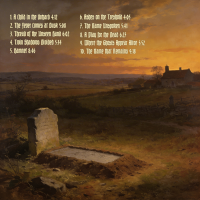
“The Silence After Salvation”
A cold, surgical piece. Clean guitar figures drift like ash before being crushed by angular riffs. Bruce whispers:
“No angels came… no thunder spoke—
just silence where the promise broke.”
Minimal. Devastating.
“Nails Through the Firmament
The first epic—and a towering one.
Riffs spiral upward like collapsing constellations, while polyrhythmic drumming evokes cosmic instability. Midway through, the song fractures into a near-ritualistic passage before detonating again.
"Drive the iron through the sky—
let the universe feel what it denied.”
Here, the crucifixion becomes cosmic, the suffering universalized.
“A God That Learned to Doubt”
Perhaps the most unsettling track.
A shifting time signature anchors a descending riff that feels like theological collapse in motion.
“I was certainty… I was flame—
now I whisper my own name.”
Bruce doesn’t just question faith—he embodies its unraveling.
“Dust and the Shape of Nothing”
Short, sharp, existential.
Minimalist verses explode into dissonant choruses. The lyrics cut straight to the void:
“We are outlines in a dying light—
drawn by hands that lost their sight.”
“Crown of Thorns, Crown of Ash”
The centerpiece.
A labyrinthine structure of shifting riffs, acoustic interludes, and choral overlays. This is where The Chemical Wedding spirit burns brightest—ritualistic, symbolic, deeply layered.
“Wear the crown they made of lies—
feel it turn to ash inside.”
By the final movement, the song dissolves into near silence before erupting one last time—an execution, not a resolution.
“Where the Universe Turned Away”
Cold. Expansive. Merciless.
This is the album’s most cosmic moment—guitars stretch into vast, echoing spaces while Bruce sounds almost distant, as if broadcasting from beyond.
“I called your name across the void—
the void replied: ‘destroyed… destroyed…’”
“Hope in the Mouth of the Void”
The closing statement—and perhaps the most complex.
Built on a slow, ascending motif, the track gradually introduces layers of harmony, suggesting something fragile, almost human.
“If nothing waits beyond the veil—
then hope is all we dare to nail.”
It’s not redemption.
It’s not despair.
It’s defiance in the absence of meaning.
MUSICAL DNA
What makes The Crown of Disillusion extraordinary is how it balances:Thrash precision → tight, angular, punishing.
Progressive structure → evolving movements, thematic returns.
Mystical atmosphere → layered harmonies, ritualistic pacing.
This is not chaos. It is controlled collapse.
The band plays with surgical intensity, yet never loses the sense of ceremony that defined The Chemical Wedding. Riffs feel carved, not written. Solos don’t merely shred—they lament, accuse, and ascend.
FINAL VERDICT
In an era where much of metal plays it safe, The Crown of Disillusion arrives like a blasphemous revelation carved in iron.
It is:
heavier than expected
smarter than most
darker than almost anything in Bruce’s catalog
And yet, beneath all the fury, there is something else:
A question.
A wound.
A flicker.
Above all, it is a statement.
A statement that asks:
What if there is no salvation?
What if the sacrifice meant nothing?
What if the silence is all there ever was?
And yet… somewhere within the wreckage, it leaves a final, stubborn spark.
This is not just another solo album. This is Bruce Dickinson reborn in fire and doubt - delivering one of the most daring, punishing, and intellectually ferocious records of his career.
A true pearl in today’s musical landscape.
And perhaps... his most human work yet.
5 / 5 — A blackened crown of absolute authority
Last edited: