

Azas
Waiting for the Barbarians
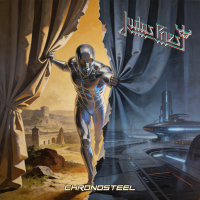
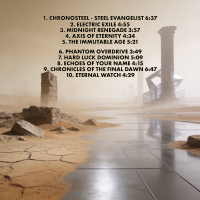
Forged Beyond Time: Chronosteel and the Late-Era Resurrection of Judas Priest
By Adrian Voss — March 18, 2027
Published in Obsidian Sound
When a band reaches the late chapters of its career, expectations usually soften. Legacy replaces urgency. Not so with Judas Priest. Chronosteel doesn’t merely defy that expectation — it detonates it. This is lightning in a bottle: an album that fuses the icy intellect of Stained Class, the streamlined attack of Screaming for Vengeance, and the turbocharged ferocity of Painkiller into something that feels both archival and startlingly alive.
Even more astonishing is the lineup. The return of K. K. Downing alongside Richie Faulkner and Andy Sneap creates a triple-guitar architecture that feels less like excess and more like revelation. Downing’s slicing, wide-interval phrasing collides with Faulkner’s modern, fluid aggression, while Sneap stitches everything together with precise, muscular rhythm work. The result is layered yet razor-sharp — classic Priest steel reforged into something mythic.
The album’s thematic backbone is time in its grandest sense: eras, eons, eternity, and the unknowable horizon at the end of existence. Yet this is no rigid concept record. Chronosteel thrives on variety — cosmic speculation sits beside street-level defiance, night-riding anthems, and a haunting ballad about lost love that refuses to fade.
The opening title suite, “Chronosteel – Steel Evangelist,” immediately plants a Painkiller-era flag. A mechanical drum barrage gives way to a spiraling three-guitar assault, with Downing firing shrieking harmonics while Faulkner tears into a cascading lead run. The lyrics read like a metallic gospel: steel as faith, time as crucible, humanity forged in pressure. It’s relentless, triumphant, and unapologetically grand.
“Electric Exile” shifts sharply into Stained Class territory. Leaner, colder, and more mysterious, the guitars weave angular harmonies over a stalking rhythm. The lyrics sketch a solitary figure roaming neon-lit streets, cut off from the world yet driven by voltage and instinct. It’s Priest at their most cerebral — metallic but introspective.
“Midnight Renegade” channels Screaming for Vengeance with a driving, aerodynamic groove. Faulkner’s rhythm chugs propel the song forward while Sneap layers tight harmonized accents. The chorus is pure arena metal — rebellious, nocturnal, and defiantly alive. It’s the album’s speed-and-freedom manifesto.
The epic “The Immutable Age” returns to Stained Class’s philosophical weight. Slow-burning riffs rise into vast, echoing leads, while the lyrics contemplate cycles of civilizations collapsing into dust. Downing’s solo here is a highlight — bending notes into long, mournful arcs that feel almost orchestral.
Track six, “Phantom Overdrive,” snaps the throttle back open with unmistakable Painkiller energy. Rapid-fire riffing and interlocking solos create a sense of unstoppable acceleration. The guitars chase each other in overlapping runs, evoking speed driven by something unseen — instinct, fate, or doom.
“Hard Luck Dominion” stands as the album’s Screaming for Vengeance-style anthem, unmistakably in the lineage of “You’ve Got Another Thing Comin’.” Big hooks, swaggering rhythm, and a defiant lyrical stance about surviving against the odds make it instantly memorable. The twin leads climb skyward before locking into a triumphant harmony.
Then comes “Echoes of Your Name,” a ballad akin to “Before the Dawn.” Clean guitars shimmer while restrained leads weep quietly in the background. The lyrics focus on long-lost love — memory lingering like a ghost, pain softened but never erased. It’s understated, heartfelt, and beautifully placed.
“Chronicles of the Final Dawn” returns to Stained Class mysticism. The guitars alternate between eerie clean passages and towering riffs, narrating the final sunrise at the end of time itself. Layered harmonies build a cosmic scale that feels both ominous and majestic.
Meanwhile, “Axis of Eternity” and “Eternal Watch” stand as beasts on their own. The former blends progressive riff shifts with towering choruses, while the closer delivers a slow-burning, monumental finale — solemn, reflective, and heavy with finality. Sneap’s dense rhythm tone anchors both tracks, allowing Downing and Faulkner to paint vast melodic arcs overhead.
Throughout Chronosteel, Priest balance cosmic contemplation with earthly fire: anthems of speed, night life, rebellion in the face of doom, and the quiet devastation of love lost to time. It’s varied without losing cohesion, heavy without sacrificing nuance.
Albums of this caliber are rare — the kind that feel less like releases and more like artifacts. Chronosteel is evangelical in its devotion to metal’s past, yet fearless in pushing forward. In their twilight years, Judas Priest have once again forged something spectacular: a record that feels eternal, defiant, and impossibly alive.
***
White-Hot Steel: Chronosteel and the Unstoppable Fury of Judas Priest
By Marcus Hale — April 2, 2027
Published in Iron Pulse
There’s something gloriously unreal about hearing a late-career album from Judas Priest that sounds this hungry. Chronosteel doesn’t coast on legacy — it revvs the engine, drops the clutch, and launches straight into orbit. It’s a wild, ecstatic collision of the cerebral chill of Stained Class, the streamlined muscle of Screaming for Vengeance, and the high-velocity fury of Painkiller. And somehow, it never feels forced. It just works.
The triple-guitar assault of K. K. Downing, Richie Faulkner, and Andy Sneap is dazzling — but the real engine room is the ironclad rhythm section. Scott Travis is a thunder machine, switching from double-kick barrages to tight, swinging grooves with surgical precision, while Ian Hill locks everything down with that unmistakable rolling low-end pulse. Hill’s bass often doubles the riff an octave down, giving the guitars that classic Priest “steel beam” foundation, while Travis peppers fills that propel transitions like controlled explosions.
“Forged in fire beyond belief / I preach the gospel of chrome and steel.”
Downing’s screaming bends collide with Faulkner’s fluid shredding — pure metallic theatre.
“Neon shadows call my name / exile wired to the flame.”
It’s mysterious, nocturnal, and hypnotic.
“Run the night, no chains remain / midnight blood in rebel veins.”
“Turn the wheel, let ages fall / I stand outside the end of all.”
Epic, but muscular.
“Empires fade but steel remains / carved in dust of endless plains.”
The solo section glows with eerie, sustained harmonies.
“Ghost in the engine, throttle wide / phantom force I cannot hide.”
Travis’s rapid-fire fills push the tempo to the brink.
“Hard luck rising, still I stand / kings are broken by my hand.”
Instant crowd roar.
“Your voice remains in fading flame / I live inside the echoes of your name.”
Melancholy, beautiful, and timeless.
“Final sunrise, burning slow / what awaits we’ll never know.”
The guitars form a three-part harmony that feels cathedral-sized.
“Standing guard beyond the night / eternal watch in fading light.”
A powerful, dignified finale.
Across the album, the interplay is electrifying. Travis’s precise double-kick patterns drive the faster tracks, while Hill’s steady pulse gives the riffs mass and movement. The guitars stack harmonies, trade solos, and lock into rhythmic unison like precision machinery.
Chronosteel is wildly varied — cosmic epics, speed assaults, anthems, and a heartfelt ballad — yet every song delivers. It’s exuberant, dramatic, and ridiculously fun. Albums like this shouldn’t happen so late in a band’s life… but Judas Priest have done it again. A gleaming artifact, a defiant roar, and a euphoric reminder that metal’s flame still burns white-hot.
***
Title of Study:
Chronosteel and the Ontology of Metal: Pre-Temporal Matter, Eschatological Time, and the Evangelical Alloy in Late-Period Judas Priest
Author:
Dr. Alistair V. Hensley
Affiliation:
Department of Cultural Metaphysics and Modern Myth Studies
St. Edmund’s Institute for Aesthetic Philosophy, Cambridge
Published in:
Journal of Heavy Metal Hermeneutics
Volume 14, Issue 2 — Autumn 2027
Special Issue: Eternity, Steel, and Sonic Eschatology
*
In the late-period discography of Judas Priest, Chronosteel emerges less as an album and more as a metaphysical proposition: a speculative ontology of time rendered in steel, prophecy, and eschatological resolve. Where earlier works mythologized rebellion or velocity, Chronosteel contemplates temporality itself — not merely time as duration, but time as substance, architecture, and ultimately as something that can be forged.
The opening suite, “Chronosteel – Steel Evangelist,” introduces the album’s foundational paradox: a metal that predates chronology. Chronosteel is not mined, nor manufactured; it is posited as pre-temporal matter — a Platonic alloy existing prior to becoming. One is tempted to read it as a metallic analogue to Aristotle’s prime mover, or perhaps a Nietzschean eternal return hardened into tangible form. The lyrics imply that Chronosteel precedes history and yet generates it, an impossible recursion: steel before fire, doctrine before voice.
From this emerges the “Steel Evangelist,” a figure who does not merely wield the metal but interprets it. The Evangelist becomes intermediary between pre-temporal matter and temporal consciousness — prophet of an alloy that remembers futures not yet lived. The album therefore establishes a theological structure: Chronosteel as divine substance, Evangelist as apostle, and humanity as recipients of metallurgical revelation.
It is here that Rob Halford reveals himself as something akin to a modern metaphysical poet — closer, perhaps, to Johann Wolfgang von Goethe than to any conventional lyricist. Halford’s language oscillates between abstraction and proclamation, constructing philosophical scaffolding while maintaining operatic clarity. One suspects that, given sufficient time, graduate seminars might emerge devoted entirely to the ontological implications of lines such as: “Forged before the dawn of thought / the blade that history forgot.”
“Electric Exile” shifts the inquiry inward. If Chronosteel represents pre-temporal matter, exile represents consciousness estranged from time. The narrator wanders a neon-lit void, detached from chronology, experiencing existence as a continuous present. The exile is not merely social but temporal — a subject displaced from history, inhabiting duration without narrative. One might call this Heideggerian metal: being-toward-eternity expressed through luminous solitude.
“Midnight Renegade” introduces motion, not as travel but as resistance to temporal determinism. The renegade outruns the night, yet the night persists — an allegory for human agency within predetermined cosmic cycles. The lyrics suggest defiance not against authority, but against inevitability itself. Here the album’s recurring theme emerges: speed as metaphysical protest.
“Axis of Eternity” presents perhaps the record’s most explicit philosophical architecture. Eternity is not portrayed as endless duration but as an axis — a fixed line around which eras rotate. The imagery recalls medieval cosmology, the axis mundi, yet rendered in metallic vocabulary. Time becomes circular, civilizations sedimentary, and consciousness merely a transient orbit. The song’s text implies that to perceive the axis is to step outside history — a revelation bordering on apocalyptic enlightenment.
“The Immutable Age” deepens this notion. Ages change; the Age does not. The distinction is subtle yet profound. Halford constructs a layered ontology: mutable epochs contained within an unchanging temporal condition. This is metaphysics disguised as prophecy. The Age is both container and constant — a timeless framework in which all change is superficial. One half expects footnotes referencing Parmenides.
The second half of the album turns from cosmic abstraction to existential implication. “Phantom Overdrive” suggests acceleration beyond measurable time — motion so extreme that causality dissolves. The phantom becomes an unseen force propelling existence toward unknowable conclusions. One might read this as technological transcendence or, more mischievously, as Kantian velocity.
“Hard Luck Dominion” grounds the metaphysical in human struggle. Dominion here is not empire but survival — sovereignty over one’s fate within collapsing timelines. The song proposes that defiance itself is a metaphysical act: to persist despite entropy is to assert meaning against oblivion.
“Echoes of Your Name” introduces memory as counterweight to cosmic scale. If Chronosteel is pre-temporal, memory is post-temporal — emotion lingering after events dissolve. The lost love described here becomes eternal precisely because it is absent. Pain, paradoxically, becomes permanence. The metaphysical expands inward; eternity is found not only in eons but in the persistence of longing.
“Chronicles of the Final Dawn” approaches eschatology. The final sunrise suggests not destruction but culmination — the moment when time recognizes its own finitude. The lyrics hover between apocalypse and transcendence, as if the end of time is less catastrophe than unveiling.
Finally, “Eternal Watch” resolves the album not with closure but vigilance. Eternity requires observation; someone must witness the endless. The narrator stands guard beyond chronology, neither living nor dead, but aware. It is a strangely dignified conclusion: consciousness as sentinel at the boundary of existence.
Taken as a whole, Chronosteel proposes that time is forge, steel is memory, and humanity is interpreter. It is absurdly grand — perhaps intentionally so — yet delivered with such conviction that skepticism dissolves into admiration. One finishes the album half-expecting academic conferences titled Metallurgy and Metaphysics: The Chronosteel Paradigm.
In their twilight years, Judas Priest have not merely released another record; they have constructed a philosophical artifact. A pre-temporal alloy, a prophetic voice, an axis of eternity — all coexisting in a work that is simultaneously profound and faintly, gloriously excessive. Whether one reads it as metaphysics, mythology, or inspired overreach, Chronosteel stands as a monument: steel before time, thought after sound, and somewhere between them, revelation.
*
Citation Format:
Hensley, Alistair V. “Chronosteel and the Ontology of Metal: Pre-Temporal Matter, Eschatological Time, and the Evangelical Alloy in Late-Period Judas Priest.” Journal of Heavy Metal Hermeneutics, vol. 14, no. 2, 2026, pp. 77–118.
Editor’s Note:
“Dr. Hensley’s essay represents one of the most ambitious attempts to reconcile metaphysical philosophy with late-period heavy metal. Whether read as rigorous scholarship or brilliantly elaborate overinterpretation, it stands as a landmark contribution to Priest studies.”
Keywords:
Chronosteel, metaphysics of metal, temporal ontology, eschatology, Halford poetics, eternal return, metallurgical symbolism, philosophical heavy metal
By Adrian Voss — March 18, 2027
Published in Obsidian Sound
When a band reaches the late chapters of its career, expectations usually soften. Legacy replaces urgency. Not so with Judas Priest. Chronosteel doesn’t merely defy that expectation — it detonates it. This is lightning in a bottle: an album that fuses the icy intellect of Stained Class, the streamlined attack of Screaming for Vengeance, and the turbocharged ferocity of Painkiller into something that feels both archival and startlingly alive.
Even more astonishing is the lineup. The return of K. K. Downing alongside Richie Faulkner and Andy Sneap creates a triple-guitar architecture that feels less like excess and more like revelation. Downing’s slicing, wide-interval phrasing collides with Faulkner’s modern, fluid aggression, while Sneap stitches everything together with precise, muscular rhythm work. The result is layered yet razor-sharp — classic Priest steel reforged into something mythic.
The album’s thematic backbone is time in its grandest sense: eras, eons, eternity, and the unknowable horizon at the end of existence. Yet this is no rigid concept record. Chronosteel thrives on variety — cosmic speculation sits beside street-level defiance, night-riding anthems, and a haunting ballad about lost love that refuses to fade.
The opening title suite, “Chronosteel – Steel Evangelist,” immediately plants a Painkiller-era flag. A mechanical drum barrage gives way to a spiraling three-guitar assault, with Downing firing shrieking harmonics while Faulkner tears into a cascading lead run. The lyrics read like a metallic gospel: steel as faith, time as crucible, humanity forged in pressure. It’s relentless, triumphant, and unapologetically grand.
“Electric Exile” shifts sharply into Stained Class territory. Leaner, colder, and more mysterious, the guitars weave angular harmonies over a stalking rhythm. The lyrics sketch a solitary figure roaming neon-lit streets, cut off from the world yet driven by voltage and instinct. It’s Priest at their most cerebral — metallic but introspective.
“Midnight Renegade” channels Screaming for Vengeance with a driving, aerodynamic groove. Faulkner’s rhythm chugs propel the song forward while Sneap layers tight harmonized accents. The chorus is pure arena metal — rebellious, nocturnal, and defiantly alive. It’s the album’s speed-and-freedom manifesto.
The epic “The Immutable Age” returns to Stained Class’s philosophical weight. Slow-burning riffs rise into vast, echoing leads, while the lyrics contemplate cycles of civilizations collapsing into dust. Downing’s solo here is a highlight — bending notes into long, mournful arcs that feel almost orchestral.
Track six, “Phantom Overdrive,” snaps the throttle back open with unmistakable Painkiller energy. Rapid-fire riffing and interlocking solos create a sense of unstoppable acceleration. The guitars chase each other in overlapping runs, evoking speed driven by something unseen — instinct, fate, or doom.
“Hard Luck Dominion” stands as the album’s Screaming for Vengeance-style anthem, unmistakably in the lineage of “You’ve Got Another Thing Comin’.” Big hooks, swaggering rhythm, and a defiant lyrical stance about surviving against the odds make it instantly memorable. The twin leads climb skyward before locking into a triumphant harmony.
Then comes “Echoes of Your Name,” a ballad akin to “Before the Dawn.” Clean guitars shimmer while restrained leads weep quietly in the background. The lyrics focus on long-lost love — memory lingering like a ghost, pain softened but never erased. It’s understated, heartfelt, and beautifully placed.
“Chronicles of the Final Dawn” returns to Stained Class mysticism. The guitars alternate between eerie clean passages and towering riffs, narrating the final sunrise at the end of time itself. Layered harmonies build a cosmic scale that feels both ominous and majestic.
Meanwhile, “Axis of Eternity” and “Eternal Watch” stand as beasts on their own. The former blends progressive riff shifts with towering choruses, while the closer delivers a slow-burning, monumental finale — solemn, reflective, and heavy with finality. Sneap’s dense rhythm tone anchors both tracks, allowing Downing and Faulkner to paint vast melodic arcs overhead.
Throughout Chronosteel, Priest balance cosmic contemplation with earthly fire: anthems of speed, night life, rebellion in the face of doom, and the quiet devastation of love lost to time. It’s varied without losing cohesion, heavy without sacrificing nuance.
Albums of this caliber are rare — the kind that feel less like releases and more like artifacts. Chronosteel is evangelical in its devotion to metal’s past, yet fearless in pushing forward. In their twilight years, Judas Priest have once again forged something spectacular: a record that feels eternal, defiant, and impossibly alive.
***
White-Hot Steel: Chronosteel and the Unstoppable Fury of Judas Priest
By Marcus Hale — April 2, 2027
Published in Iron Pulse
There’s something gloriously unreal about hearing a late-career album from Judas Priest that sounds this hungry. Chronosteel doesn’t coast on legacy — it revvs the engine, drops the clutch, and launches straight into orbit. It’s a wild, ecstatic collision of the cerebral chill of Stained Class, the streamlined muscle of Screaming for Vengeance, and the high-velocity fury of Painkiller. And somehow, it never feels forced. It just works.
The triple-guitar assault of K. K. Downing, Richie Faulkner, and Andy Sneap is dazzling — but the real engine room is the ironclad rhythm section. Scott Travis is a thunder machine, switching from double-kick barrages to tight, swinging grooves with surgical precision, while Ian Hill locks everything down with that unmistakable rolling low-end pulse. Hill’s bass often doubles the riff an octave down, giving the guitars that classic Priest “steel beam” foundation, while Travis peppers fills that propel transitions like controlled explosions.
1. Chronosteel – Steel Evangelist
The opener explodes with Painkiller-grade intensity. Travis fires off a double-kick gallop while the three guitars spiral into harmonized chaos. The chorus lands like a proclamation:“Forged in fire beyond belief / I preach the gospel of chrome and steel.”
Downing’s screaming bends collide with Faulkner’s fluid shredding — pure metallic theatre.
2. Electric Exile
Suddenly colder, sharper — classic Stained Class mood. Hill’s bass walks underneath a stalking riff while Travis keeps it minimal, letting space build tension.“Neon shadows call my name / exile wired to the flame.”
It’s mysterious, nocturnal, and hypnotic.
3. Midnight Renegade
Full Screaming for Vengeance adrenaline. Tight palm-muted chugs, big hooks, and a sky-punching chorus. Travis switches to a driving four-on-the-floor kick pattern that screams arena metal.“Run the night, no chains remain / midnight blood in rebel veins.”
4. Axis of Eternity
Hard to categorize — a beast of shifting riffs and towering melodies. Hill’s bass anchors a slow, grinding motif before the guitars climb into layered harmonies.“Turn the wheel, let ages fall / I stand outside the end of all.”
Epic, but muscular.
5. The Immutable Age
Back to Stained Class philosophical territory. Sneap’s rhythm tone is massive while Travis accents the riff with syncopated snare hits.“Empires fade but steel remains / carved in dust of endless plains.”
The solo section glows with eerie, sustained harmonies.
6. Phantom Overdrive
Another Painkiller-style blast. Double-kick barrage, racing riffs, and guitars chasing each other like sparks.“Ghost in the engine, throttle wide / phantom force I cannot hide.”
Travis’s rapid-fire fills push the tempo to the brink.
7. Hard Luck Dominion
Anthem time. This one struts like “You’ve Got Another Thing Comin’” reborn. Hill’s bass groove swings, Travis loosens into a punchy backbeat, and the chorus is huge:“Hard luck rising, still I stand / kings are broken by my hand.”
Instant crowd roar.
8. Echoes of Your Name
The ballad — tender but not soft. Clean guitars shimmer while Hill’s subtle bass lines add warmth. Travis uses restrained cymbal work and tom accents.“Your voice remains in fading flame / I live inside the echoes of your name.”
Melancholy, beautiful, and timeless.
9. Chronicles of the Final Dawn
Cosmic Stained Class grandeur. Layered harmonies, dramatic tempo shifts, and a massive chorus.“Final sunrise, burning slow / what awaits we’ll never know.”
The guitars form a three-part harmony that feels cathedral-sized.
10. Eternal Watch
The closer marches in with weight and authority. Hill’s bass rumbles like distant thunder while Travis builds tension with measured, deliberate hits.“Standing guard beyond the night / eternal watch in fading light.”
A powerful, dignified finale.
Across the album, the interplay is electrifying. Travis’s precise double-kick patterns drive the faster tracks, while Hill’s steady pulse gives the riffs mass and movement. The guitars stack harmonies, trade solos, and lock into rhythmic unison like precision machinery.
Chronosteel is wildly varied — cosmic epics, speed assaults, anthems, and a heartfelt ballad — yet every song delivers. It’s exuberant, dramatic, and ridiculously fun. Albums like this shouldn’t happen so late in a band’s life… but Judas Priest have done it again. A gleaming artifact, a defiant roar, and a euphoric reminder that metal’s flame still burns white-hot.
***
Title of Study:
Chronosteel and the Ontology of Metal: Pre-Temporal Matter, Eschatological Time, and the Evangelical Alloy in Late-Period Judas Priest
Author:
Dr. Alistair V. Hensley
Affiliation:
Department of Cultural Metaphysics and Modern Myth Studies
St. Edmund’s Institute for Aesthetic Philosophy, Cambridge
Published in:
Journal of Heavy Metal Hermeneutics
Volume 14, Issue 2 — Autumn 2027
Special Issue: Eternity, Steel, and Sonic Eschatology
*
In the late-period discography of Judas Priest, Chronosteel emerges less as an album and more as a metaphysical proposition: a speculative ontology of time rendered in steel, prophecy, and eschatological resolve. Where earlier works mythologized rebellion or velocity, Chronosteel contemplates temporality itself — not merely time as duration, but time as substance, architecture, and ultimately as something that can be forged.
The opening suite, “Chronosteel – Steel Evangelist,” introduces the album’s foundational paradox: a metal that predates chronology. Chronosteel is not mined, nor manufactured; it is posited as pre-temporal matter — a Platonic alloy existing prior to becoming. One is tempted to read it as a metallic analogue to Aristotle’s prime mover, or perhaps a Nietzschean eternal return hardened into tangible form. The lyrics imply that Chronosteel precedes history and yet generates it, an impossible recursion: steel before fire, doctrine before voice.
From this emerges the “Steel Evangelist,” a figure who does not merely wield the metal but interprets it. The Evangelist becomes intermediary between pre-temporal matter and temporal consciousness — prophet of an alloy that remembers futures not yet lived. The album therefore establishes a theological structure: Chronosteel as divine substance, Evangelist as apostle, and humanity as recipients of metallurgical revelation.
It is here that Rob Halford reveals himself as something akin to a modern metaphysical poet — closer, perhaps, to Johann Wolfgang von Goethe than to any conventional lyricist. Halford’s language oscillates between abstraction and proclamation, constructing philosophical scaffolding while maintaining operatic clarity. One suspects that, given sufficient time, graduate seminars might emerge devoted entirely to the ontological implications of lines such as: “Forged before the dawn of thought / the blade that history forgot.”
“Electric Exile” shifts the inquiry inward. If Chronosteel represents pre-temporal matter, exile represents consciousness estranged from time. The narrator wanders a neon-lit void, detached from chronology, experiencing existence as a continuous present. The exile is not merely social but temporal — a subject displaced from history, inhabiting duration without narrative. One might call this Heideggerian metal: being-toward-eternity expressed through luminous solitude.
“Midnight Renegade” introduces motion, not as travel but as resistance to temporal determinism. The renegade outruns the night, yet the night persists — an allegory for human agency within predetermined cosmic cycles. The lyrics suggest defiance not against authority, but against inevitability itself. Here the album’s recurring theme emerges: speed as metaphysical protest.
“Axis of Eternity” presents perhaps the record’s most explicit philosophical architecture. Eternity is not portrayed as endless duration but as an axis — a fixed line around which eras rotate. The imagery recalls medieval cosmology, the axis mundi, yet rendered in metallic vocabulary. Time becomes circular, civilizations sedimentary, and consciousness merely a transient orbit. The song’s text implies that to perceive the axis is to step outside history — a revelation bordering on apocalyptic enlightenment.
“The Immutable Age” deepens this notion. Ages change; the Age does not. The distinction is subtle yet profound. Halford constructs a layered ontology: mutable epochs contained within an unchanging temporal condition. This is metaphysics disguised as prophecy. The Age is both container and constant — a timeless framework in which all change is superficial. One half expects footnotes referencing Parmenides.
The second half of the album turns from cosmic abstraction to existential implication. “Phantom Overdrive” suggests acceleration beyond measurable time — motion so extreme that causality dissolves. The phantom becomes an unseen force propelling existence toward unknowable conclusions. One might read this as technological transcendence or, more mischievously, as Kantian velocity.
“Hard Luck Dominion” grounds the metaphysical in human struggle. Dominion here is not empire but survival — sovereignty over one’s fate within collapsing timelines. The song proposes that defiance itself is a metaphysical act: to persist despite entropy is to assert meaning against oblivion.
“Echoes of Your Name” introduces memory as counterweight to cosmic scale. If Chronosteel is pre-temporal, memory is post-temporal — emotion lingering after events dissolve. The lost love described here becomes eternal precisely because it is absent. Pain, paradoxically, becomes permanence. The metaphysical expands inward; eternity is found not only in eons but in the persistence of longing.
“Chronicles of the Final Dawn” approaches eschatology. The final sunrise suggests not destruction but culmination — the moment when time recognizes its own finitude. The lyrics hover between apocalypse and transcendence, as if the end of time is less catastrophe than unveiling.
Finally, “Eternal Watch” resolves the album not with closure but vigilance. Eternity requires observation; someone must witness the endless. The narrator stands guard beyond chronology, neither living nor dead, but aware. It is a strangely dignified conclusion: consciousness as sentinel at the boundary of existence.
Taken as a whole, Chronosteel proposes that time is forge, steel is memory, and humanity is interpreter. It is absurdly grand — perhaps intentionally so — yet delivered with such conviction that skepticism dissolves into admiration. One finishes the album half-expecting academic conferences titled Metallurgy and Metaphysics: The Chronosteel Paradigm.
In their twilight years, Judas Priest have not merely released another record; they have constructed a philosophical artifact. A pre-temporal alloy, a prophetic voice, an axis of eternity — all coexisting in a work that is simultaneously profound and faintly, gloriously excessive. Whether one reads it as metaphysics, mythology, or inspired overreach, Chronosteel stands as a monument: steel before time, thought after sound, and somewhere between them, revelation.
*
Citation Format:
Hensley, Alistair V. “Chronosteel and the Ontology of Metal: Pre-Temporal Matter, Eschatological Time, and the Evangelical Alloy in Late-Period Judas Priest.” Journal of Heavy Metal Hermeneutics, vol. 14, no. 2, 2026, pp. 77–118.
Editor’s Note:
“Dr. Hensley’s essay represents one of the most ambitious attempts to reconcile metaphysical philosophy with late-period heavy metal. Whether read as rigorous scholarship or brilliantly elaborate overinterpretation, it stands as a landmark contribution to Priest studies.”
Keywords:
Chronosteel, metaphysics of metal, temporal ontology, eschatology, Halford poetics, eternal return, metallurgical symbolism, philosophical heavy metal
Last edited: